Introduction
Two recent 2025 papers offer insights into how artificial intelligence (AI) can impact acute and critical care, each from a different perspective. The first, “Artificial intelligence in resuscitation: a scoping review” (Resuscitation Plus, 2025), maps out current AI applications in cardiac arrest and resuscitation contexts. The second, “Implementing AI in critical care medicine: a consensus of 22” (Critical Care, 2025), is an expert-driven consensus focusing on AI integration in the intensive care unit (ICU) and critical care setting. Below, we compare these papers in terms of their clinical focus, methodologies, key findings on AI applications, implementation challenges, regulatory/ethical perspectives, and recommendations. We also highlight where they agree or diverge, providing a concise synthesis for readers.
Focus and Clinical Application Areas
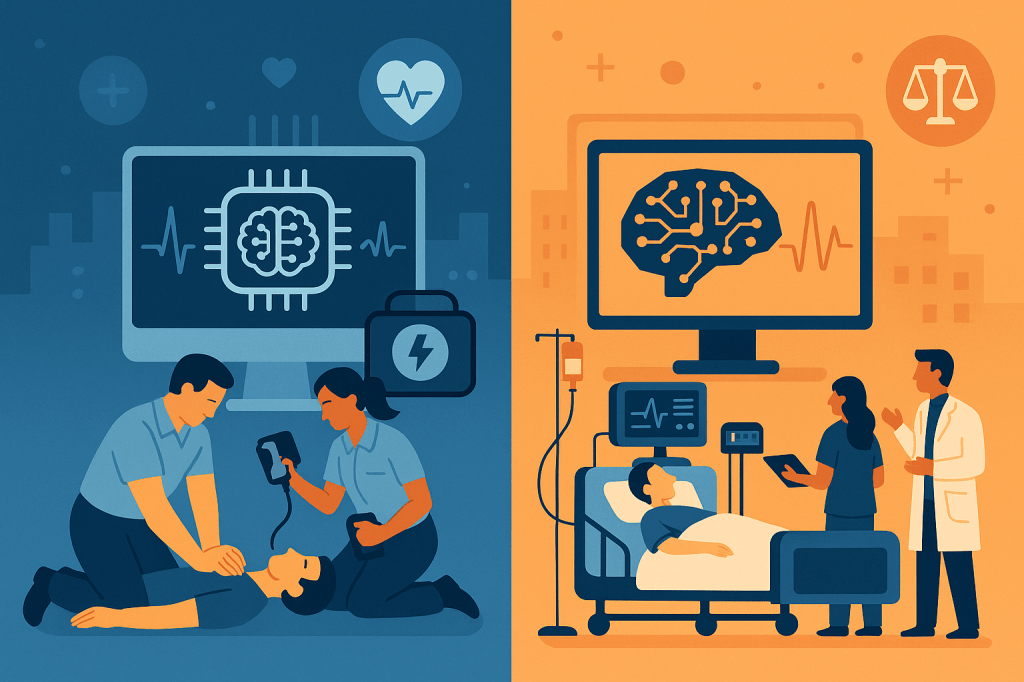
Resuscitation (Cardiac Arrest) vs. Critical Care (ICU): The scoping review by Zace et al. centers on cardiac arrest (CA) and resuscitation – essentially the emergency response continuum from collapse through post-resuscitation care. It catalogues AI tools aimed at improving outcomes in cardiac arrest, such as:
- Early CA prediction and detection: Machine learning models to anticipate in-hospital cardiac arrest (e.g. early warning scores enhanced by AI) and to promptly recognize out-of-hospital cardiac arrest from emergency calls. For instance, some AI systems analyzed patient vital signs or EMS call audio to detect arrests faster than humans.
- Rhythm analysis and CPR support: AI (including deep learning) applied to ECG rhythm classification and real-time CPR guidance. Examples include algorithms to determine shockable vs. non-shockable rhythms and systems that predict the presence of a pulse or the need for defibrillation without pausing compressions. Vision-based models and wearables also monitored CPR quality (compression depth/rate) with high accuracy in simulations.
- Post-resuscitation prognostication: Tools to forecast outcomes after return of spontaneous circulation (ROSC). Several studies used AI on post-arrest data (such as EEG patterns, CT scans, or clinical variables) to predict neurological recovery or survival, with some reporting very high discriminative performance (AUROC >0.90).
In contrast, the consensus article by Cecconi et al. addresses AI in critical care medicine broadly, covering the ICU domain which includes a range of conditions (sepsis, respiratory failure, etc.) and extended patient care. It notes AI’s potential to “enhance diagnostic precision and personalized patient management” in ICU settings, improve prognostication, and streamline workflows. Specific application areas mentioned or implied include: early warning systems for patient deterioration, AI-assisted diagnosis (e.g. sepsis detection), predictive models for outcomes in ICU patients, automation of monitoring (waveform analysis from monitors), and even AI tools for clinician training and decision support. The consensus paper is less about enumerating use-cases and more about ensuring these diverse ICU AI applications are implemented safely. Still, it acknowledges that AI is “rapidly transforming the landscape of critical care” with many opportunities if used correctly.
Domain Emphasis: Both papers therefore deal with high-stakes acute care, but at different scales. The resuscitation paper is narrowly focused on the chain of survival in cardiac arrest (from early detection to post-arrest care), whereas the critical care paper spans the broader ICU environment. Notably, there is some overlap: for example, after a cardiac arrest, patients often receive ICU care, and AI prognostic tools for post-arrest outcomes cited in the first paper relate to critical care. However, each paper tailors its discussion to its domain – one on immediate emergency response, the other on ongoing intensive care – which influences the AI applications they highlight.
Methodological Approach
The two papers employ distinct approaches reflective of their different goals:
- Scoping Review (Artificial intelligence in resuscitation): The Resuscitation Plus article is a systematic scoping review of literature. The authors followed a PRISMA-ScR framework to identify and map all relevant studies on AI in resuscitation up to end of 2024. They searched multiple databases (PubMed, EMBASE, Cochrane) with broad terms (AI, machine learning, deep learning, CPR, cardiac arrest, etc.) and included 197 studies meeting criteria. Most included studies were observational – “predominantly retrospective (0%), with only 16 prospective studies and 2 randomized controlled trials”. The review systematically classified these papers by AI methodology used, clinical task, study design, and outcomes. This quantitative mapping allowed the authors to identify trends (e.g. which AI techniques are most common) and gaps in the existing research. No meta-analysis was done (due to heterogeneity of outcomes), but performance metrics like AUROC were aggregated qualitatively. In summary, Paper 1 provides an evidence snapshot: it synthesizes published results on how AI has been applied in the resuscitation field and how well those approaches have performed so far.
- Expert Consensus (Implementing AI in critical care medicine): The Critical Care article is a consensus statement by 22 experts, developed through multidisciplinary discussions rather than a formal systematic review. The panel included intensivist clinicians, AI researchers, data scientists, and other stakeholders chosen for their contributions to AI in critical care. Over iterative sessions, they assessed the current state of ICU-focused AI and debated its challenges, without formally grading evidence (acknowledging that hard evidence is limited in this fast-moving field). The output is a “rigorous, expert-driven synthesis of key barriers and opportunities” and a set of recommendations for implementing AI in critical care. In essence, Paper 2 is a policy and practice-oriented overview – a call to action – grounded in expert opinion and consensus principles. It does not present new experimental data; instead, it interprets existing knowledge and experience to guide future AI adoption. This methodological difference means “Expert Consensus” is more qualitative and prescriptive, whereas “Scoping Review” is descriptive and data-driven. Together, they complement each other: one maps what has been done in research, the other maps what should be done to safely bring AI into practice.
Key Challenges and Barriers Identified
Both papers devote significant attention to the challenges of implementing AI in their respective contexts. There is considerable overlap in the hurdles they note, underscoring common issues in translating AI from concept to clinic, although each paper also has a unique emphasis:
- Limited Real-World Validation: Both works acknowledge that many AI models in acute care have not been adequately tested in live clinical settings. The scoping review found that despite many studies reporting high model performance (often AUROC >0.85), prospective validation was rare. Fewer than 10% of the studies had implemented an AI model in real-time clinical or EMS practice, and only 2 RCTs were identified. This highlights a “major translational gap between algorithm development and clinical deployment”. The ICU consensus echoes this concern, noting that “most AI tools remain poorly validated and untested in real settings”. The rapid proliferation of AI models outpaces the medical field’s ability to rigorously evaluate them, raising concerns about unproven tools being deployed prematurely. Both papers stress that without solid evidence from real-world trials or implementations, AI’s promise cannot be assumed safe or effective in practice.
- Data Bias and Generalizability: Equity and bias issues are a prominent theme in both papers. The resuscitation review observed that many studies used datasets from limited geographies (a large portion from high-income countries like the US and South Korea) and often single-center data. This raises questions about how well these AI models would perform in different populations – there is “limited insight into AI performance in low-resource settings or diverse populations” due to underrepresentation. The critical care consensus reinforces this, warning that AI models often underrepresent vulnerable groups, which can lead to algorithmic bias and reduced validity when applied elsewhere. They explicitly mention that models may lack temporal validity (working across time as data evolves) and geographic validity (working across hospitals/regions). Both papers call for more diverse and representative data to ensure AI tools don’t inadvertently perpetuate health disparities. In essence, they agree that data limitations (bias, silos, lack of standardization) threaten the generalizability and fairness of AI in healthcare.
- Integration into Clinical Workflow: Implementing AI is not just a technical challenge but also a workflow and human factors challenge. The scoping review notes that even a highly accurate AI alert is only useful if it “reaches the right provider at the right time and is presented in an actionable manner”. It found that few studies considered how to seamlessly embed AI tools into existing emergency or hospital workflows – an issue for future integration. The consensus paper places even greater emphasis on the human–AI interface and usability. It highlights the risk of AI tools either being ignored or, conversely, over-relied upon by clinicians. For example, if clinicians over-trust an AI (automation bias), they might miss clinical subtleties; if they under-trust it, the tool’s benefits are lost. Designing AI that complements rather than disrupts clinicians’ reasoning is a stated priority. Both papers agree that successful adoption requires fitting AI into the care process in a user-friendly way. This includes workflow integration (alerts in monitors, voice assistants during CPR as some studies attempted) and ensuring clinicians remain in the loop and empowered to interpret or override AI decisions.
- Ethical and Human-Centric Concerns: The ethics of AI and the patient-clinician relationship emerge more strongly in the ICU consensus, but the underlying concern is shared. Cecconi et al. devote attention to fears that AI could “weaken the human connection at the core of medical practice” if not implemented thoughtfully. They discuss maintaining empathy, transparency, and trust – essentially that the use of AI should not dehumanize care or alienate patients. The notion of preserving the “millenary relation between physicians and patients” is emphasized. The resuscitation review by Zace et al. does not explicitly delve into clinician–patient relationship issues (since a lot of its focus is on emergency scenarios where patient interaction is limited during CA events). However, it does stress explainability and transparency as needed qualities in AI models to foster clinician trust, which aligns with the ethical principle of maintaining clinician judgment and accountability. Both papers effectively argue that AI must be human-centric: tools should be transparent, augment human decision-making, and avoid bias – thereby keeping care equitable and patient-focused.
- Infrastructure and Big Picture Challenges: The consensus paper uniquely comments on the infrastructure and commercial influence in AI development. It notes that creating and maintaining AI systems requires “enormous computational power, infrastructure, funding, and expertise,” which currently gives major technology companies a leading role. This can misalign priorities, as tech companies’ goals might differ from frontline healthcare needs. While the resuscitation review does not directly discuss Big Tech, it similarly implies that cross-institution collaboration (potentially via federated learning and data sharing) will be needed to assemble the large, diverse datasets for robust AI. Both acknowledge that collaboration across institutions (and likely with industry) is necessary, but oversight is needed to ensure that the technology serves clinical goals. The ICU consensus explicitly calls for standardization of data (so that AI models aren’t site-specific) and development of networks for data sharing across ICUs, emergency departments, etc., to improve research and model training.
In summary, both papers concur on the major barriers: lack of prospective validation, data bias issues, challenges in integrating AI into real-world practice, and the need to maintain human oversight. The ICU consensus brings out ethical/regulatory angles more strongly (see below), reflecting its forward-looking, governance-oriented approach, whereas the resuscitation review underscores evidence gaps and technical limitations found in current studies. These differences are largely complementary – one highlights what is missing in the current research, and the other highlights what is needed for future implementation.
Regulatory and Governance Perspectives
One notable point of divergence is how much the papers discuss regulatory and governance issues:
- Resuscitation Scoping Review: Being a literature review, this paper touches only briefly on policy or regulatory matters. It does not explicitly mention regulators like the FDA or specific laws. However, it implicitly calls for standards and guidelines to support AI integration. In the discussion, the authors suggest that establishing consensus on reporting and validating AI algorithms in resuscitation (analogous to guideline development in other fields) could streamline evaluation of new tools. They also mention that interdisciplinary collaboration including policymakers will be needed to address issues like data sharing and bias. Thus, while not a focal point, Expert Consensus recognizes that an organized framework (likely involving regulatory bodies or professional societies) is important to move from isolated studies to practical, approved solutions. The emphasis is on encouraging common metrics and transparency so that AI tools can be compared and trusted.
- Critical Care Consensus: The consensus article has a dedicated focus on governance, ethics, and regulation as one of its four main domains of recommendation. The authors explicitly discuss existing and upcoming regulatory frameworks – for instance referencing the EU Artificial Intelligence Act and FDA initiatives for AI in medical devices (implying that these were considered in their analysis). They advocate involving clinicians in regulatory processes and not leaving governance solely to external bodies. A key idea introduced is the creation of a “social contract for AI in healthcare,” defining roles and responsibilities for all stakeholders including developers and regulators. This means clarity on accountability: ensuring developers build transparent and safe AI, clinicians stay educated and critically evaluate AI outputs, and regulators enforce performance standards, equity, and post-deployment monitoring. The paper even suggests hospital-level AI oversight committees as a practical governance measure to oversee implementation and ensure it aligns with values of fairness and safety. Overall, the Scoping Review strongly emphasizes that coordinated governance is critical: successful AI integration will require rules, ethical guidelines, and possibly new regulatory policies to maintain control and accountability in this high-risk environment.
In comparison, the consensus paper offers a much more detailed and explicit take on regulatory perspective than the scoping review. This difference is likely due to the nature of each piece: a consensus is forward-looking and normative (what should be done), whereas a scoping review is descriptive (what has been done). Nonetheless, both agree on the need for structured oversight. They converge on the idea that AI shouldn’t be a wild west in medicine – standards and stakeholder cooperation (including regulators) are needed to ensure safety, efficacy, and ethical use of AI tools.
Recommendations and Future Directions
Finally, both papers conclude with recommendations, though targeted at different audiences (researchers vs. practitioners/policymakers) and at different levels of detail. Here’s a summary of what each proposes and where they align:
- Recommendations from the Scoping Review: Zace et al. conclude that while AI shows “encouraging performance in prediction and decision support,” there is little proof yet of improved patient outcomes or routine use. They therefore recommend future efforts focus on several key areas:
- Prospective Validation: Conduct more prospective studies and clinical trials to test AI tools in real-world resuscitation scenarios. Without demonstrating actual outcome benefits (e.g. higher survival rates or better neurological outcomes after CA), AI will remain an experimental promise.Data Diversity and Equity: Improve the diversity of data used to train AI. This may involve international data sharing or federated learning to include underrepresented populations. Ensuring AI performance across different settings (urban vs rural, high- vs low-resource) is highlighted as crucial for equity.Explainability and Transparency: Invest in AI models that provide interpretable results. The review notes that clinicians need to trust AI recommendations, and having explainable AI could increase acceptance. This also ties into the ethical use of AI – knowing why an algorithm suggests an action can help prevent blind trust or outright dismissal by practitioners.Workflow Integration: Focus on the seamless integration of AI tools into clinical workflows and existing medical devices. The authors suggest designing alerts or decision-support such that it fits naturally into the provider’s process (e.g. integrated into monitors or defibrillators, or via voice assistants in CPR). The goal is to make AI assistance practical and non-disruptive during critical events.Standardized Evaluation: Develop standard evaluation metrics and reporting for AI in resuscitation. This would allow the field to compare results across studies better and accelerate knowledge translation. Although not explicitly labeled as a recommendation in the paper, this is implied as a way to address the heterogeneity problem noted.
- Recommendations from the Consensus: The critical care consensus puts forth actionable recommendations across four domains, each aiming to ensure that as AI is adopted, it remains ethical, effective, and centered on patient care. The major recommendation domains are:
- Human-Centric and Ethical AI: Always keep AI usage human-centric. The panel urges that AI be used to augment clinicians, not replace the compassion and empathy in care. They recommend developing AI solutions that free up clinicians (e.g. by taking over tedious documentation tasks) so clinicians can spend more time with patients. They also insist on maintaining human oversight – clinicians should be involved in AI deployment decisions and governance, and an ethical framework (like the proposed social contract) should guide AI use.Clinician Training and Education: Invest in education and training for healthcare providers on AI. This includes formal training on interpreting AI outputs and understanding AI limitations. The recommendations suggest researching the optimal ways for humans and AI to work together (e.g. UI/UX design for AI tools, cognitive support tools) so that clinicians are neither over-reliant on nor antagonistic to AI. Essentially, preparing the workforce is key to safe AI adoption.Data Standardization and Sharing: Standardize data infrastructure across institutions and encourage data sharing collaborations. By harmonizing electronic health record data models and sharing ICU datasets, the variability and silos that hinder AI performance can be reduced. The panel also notes that this must be done while safeguarding privacy and security. A network of hospitals sharing data will enable more generalizable AI tools and prevent each hospital from having to reinvent the wheel.Governance and Regulation: Strengthen AI governance and regulatory oversight in healthcare. The consensus recommends establishing clear regulations and internal policies to evaluate and monitor AI systems. They advocate for things like institutional AI committees (to oversee AI tool deployment and management), as well as active engagement with regulators to update guidelines as AI evolves. The idea is to create a controlled, continuously audited environment for AI, much like drug or device approvals, to ensure safety, efficacy, fairness, and accountability.
Alignment of Recommendations: Despite different scopes, the spirit of the recommendations in both papers align on several points. Both emphasize prospective validation: Scoping Review urges more trials in clinical settings, and Expert Consensus warns against deploying unvalidated models – effectively both demand solid evidence before full adoption. Both underscore equity and bias mitigation: the review says future work must ensure equitable data and avoid bias, and the consensus builds an entire ethical framework around fairness and avoiding disparities. Both also highlight education and collaboration: the review suggests interdisciplinary collaboration and improving explainability for clinicians, while the consensus specifically recommends clinician training and multidisciplinary oversight committees. The differences lie in emphasis: the review’s recommendations are research-focused (what studies should do next), whereas the consensus is practice-focused (what policymakers/clinicians should do to govern and adopt AI). But ultimately, both aim to ensure AI actually benefits patients. They converge on the message that AI’s technical success must translate into real-world improvements in outcomes, which will require careful validation, integration, and adherence to ethical best practices.
Conclusion
In summary, these two 2025 papers provide a high-level look at AI in acute medical care from complementary angles. The Resuscitation Plus scoping review offers a comprehensive snapshot of how AI has been used so far in cardiac arrest scenarios, highlighting impressive technical results (e.g. accurate predictions, classification, and decision support tools) but also pointing out the paucity of evidence for real clinical impact and the need for more rigorous, inclusive research. Meanwhile, the Critical Care consensus envisions the road ahead for bringing AI into ICU practice, emphasizing a framework of ethical, well-governed, and human-centered implementation so that the technology tangibly improves care without undermining the human elements of medicine.
Areas of Agreement: Both papers agree that AI holds significant promise in high-acuity settings – from saving lives in cardiac arrest to managing complex ICU patients – but they caution that this promise is still largely unfulfilled in practice. They both identify the lack of prospective validation and generalizability as major issues to overcome before AI can be trusted at the bedside. Bias reduction, data standardization, and workflow integration are mutual priorities, as is the need for collaboration across clinical and technical domains to guide AI’s evolution.
Areas of Divergence: The differences are shaped by scope and purpose. The resuscitation-focused paper is narrower and more technical, dealing with specific emergency care applications and research outcomes (e.g. model performance metrics, use-case catalogs). In contrast, the critical care paper takes a broader, system-level perspective, discussing concepts like clinician training, ethics, and regulatory policy in detail. It does not dwell on model specifics but rather on principles for any AI use in critical care. Essentially, Scoping Review asks, “What have we achieved with AI in resuscitation, and what gaps remain?”, while Expert Consensus asks, “How should we responsibly implement AI in critical care moving forward?”. Despite this difference, there is little true conflict between them – instead, they form a coherent narrative. One identifies the scientific and clinical gaps (e.g. need for more RCTs, better data diversity), and the other provides a roadmap to address such gaps (e.g. build data networks, strengthen validation and oversight).
For a reader seeking a concise synthesis: both papers underscore optimism about AI’s potential to improve acute and critical care, tempered by realism about current limitations. Whether it’s an algorithm to predict cardiac arrest or an AI system to optimize ICU workflows, rigorous evidence and ethical guardrails are essential before these tools become routine. The resuscitation review and the critical care consensus ultimately agree that AI should be an adjunct to – not a replacement for – skilled human clinicians, and that when implemented thoughtfully, AI could enhance decision-making, personalize patient care, and potentially save lives in both the emergency setting and the intensive care unit. Their combined insights guide us to proceed with both enthusiasm and caution as we integrate AI into healthcare’s most critical moments.
References
- Zace D, Semeraro F, Schnaubelt S, et al. Artificial intelligence in resuscitation: a scoping review. Resuscitation Plus. 2025;24:100973.
- Cecconi M, Greco M, Shickel B, et al. Implementing Artificial Intelligence in Critical Care Medicine: a consensus of 22. Critical Care. 2025;29:290.



 AGATA TEAM
Leave a comment