AI: The Lifesaver of Tomorrow
Imagine a world where technology anticipates a cardiac arrest before it happens, where a seamless blend of AI and cutting-edge devices saves lives with unparalleled precision. This isn’t science fiction; it’s the future of cardiac arrest management as envisioned in a groundbreaking article from Resuscitation.
Cardiac arrest is one of the deadliest medical emergencies, yet survival rates remain stubbornly low. However, the convergence of artificial intelligence (AI) and innovative technologies is poised to revolutionize how we respond to these life-threatening events. The article explores some of the main domains where AI could have a significant effect.
Early Recognition and Call for Help: The Silent Guardians
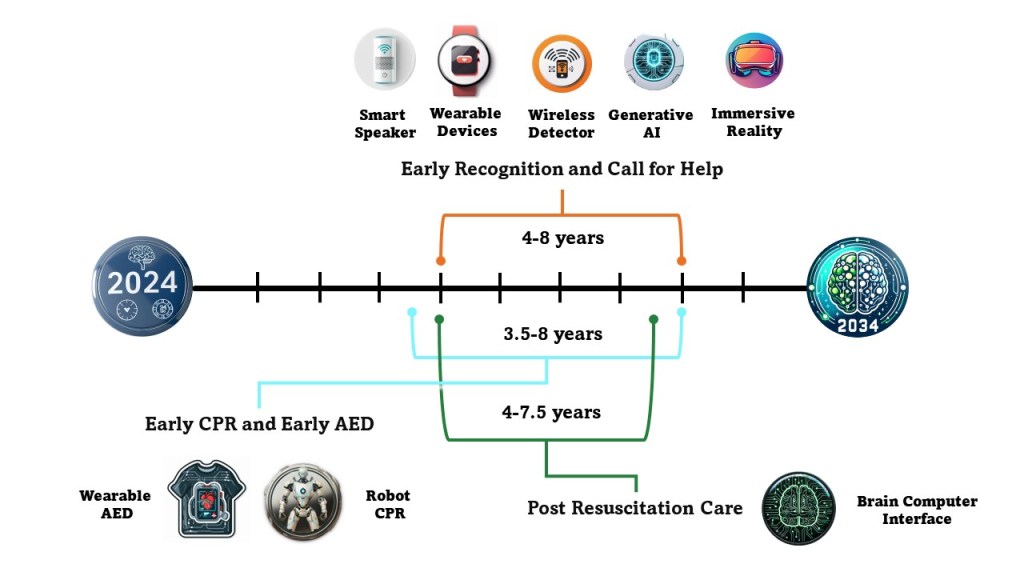
Picture this: your home is equipped with invisible guardians, quietly monitoring your vital signs. Developed by researchers like Dina Katabi, this technology uses radio waves to track breathing, heart rate, and neurological patterns without any physical contact. This innovative technology leverages everyday signals for continuous health monitoring, transforming homes into proactive healthcare environments. By integrating ambient monitoring with deep learning algorithms, it can analyze gait, detect subtle changes in vital signs, and identify suspected cardiac arrests, triggering immediate emergency responses. AI algorithms adapt to individual behaviors, offering personalized risk predictions days or hours before a cardiac event. This system can also integrate with wearable devices and smart speakers for rhythm analysis and serve as a redundant vital signs monitor. Additionally, healthcare professionals can use immersive reality for better coordination, pre-arrival instructions, and enhanced CPR training.These systems, enhanced by AI algorithms, could detect anomalies and alert emergency services before a crisis escalates. It’s a future where your home becomes a proactive player in your healthcare, ensuring that help is on the way at the first sign of trouble.
Early CPR and Early AED: Robotic Rescuers at the Ready
In this envisioned future, robots aren’t just in factories or sci-fi movies—they’re lifesavers. Automated chest compression devices could provide immediate CPR, guided by AI to ensure precision and effectiveness. Imagine a scenario where a robot detects someone collapsing and starts CPR within seconds, all while alerting emergency responders. Wearable defibrillators, designed to be as comfortable as your favorite t-shirt, could deliver life-saving shocks instantly, bridging the critical gap until professional help arrives.
Post-Resuscitation Care: The Brain-Computer Interface Revolution
Post-resuscitation care might soon involve brain-computer interfaces (BCIs). Companies like Neuralink are developing implantable devices that monitor brain activity, providing real-time data to medical professionals. These BCIs could assess neurological damage and guide treatment, potentially improving recovery outcomes. It’s a leap towards a future where technology not only saves lives but also enhances the quality of life after a cardiac arrest.
Ethical Considerations: Balancing Innovation and Privacy
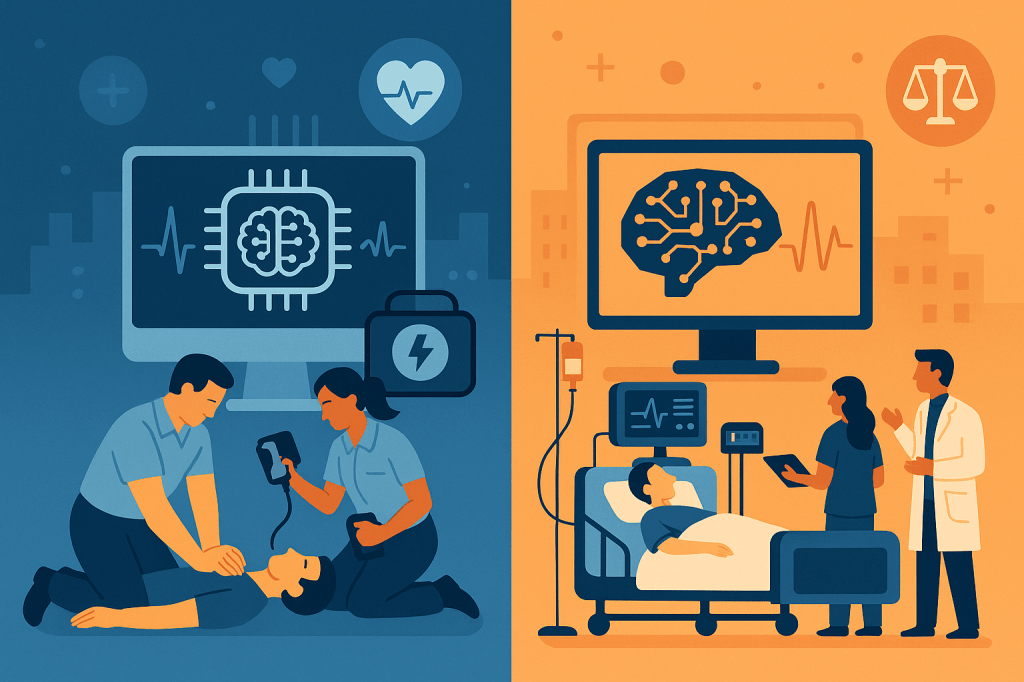
With great power comes great responsibility. The integration of AI and advanced monitoring systems into healthcare raises significant ethical questions. How do we balance the incredible benefits of these technologies with the need to protect patient privacy and data security? The European Parliament’s “Artificial Intelligence Act” is a step towards regulating AI use, but a comprehensive ethical framework will be essential. We must ensure that these innovations do not compromise patient autonomy or widen healthcare disparities.
A Vision for the Next Decade
The article paints a vivid picture of the next ten years in cardiac arrest management. As AI and technological advancements converge, we could see a dramatic improvement in survival rates and patient outcomes. However, achieving this future will require rigorous scientific validation, ethical oversight, and collaboration among technologists, medical professionals, and policymakers.
Predictions by AI Tools: ChatGPT-4 and Gemini Advanced
In their analysis, the authors consulted two of the most advanced AI tools: ChatGPT-4 and Gemini Advanced. These tools provided predictions on the implementation timelines for various technologies:
- Early Recognition and Call for Help: ChatGPT-4 estimated the implementation of ambient vital signs monitoring using radio waves and other tecnhologies within 2 to 5 years, while Gemini Advanced predicted a similar timeframe but emphasized the need to overcome technical and privacy challenges.
- Early CPR and Early AED: ChatGPT-4 predicted that robotic CPR devices and wearable defibrillators could be widely adopted within 2 to 10 years. Gemini Advanced, on the other hand, highlighted the potential technical and cost challenges, placing them in the “Trough of Disillusionment” phase but acknowledged their potential to eventually reach widespread use.
- Post-Resuscitation Care: ChatGPT-4 suggested that brain-computer interfaces could take over 10 years to deploy effectively, whereas Gemini Advanced revised its initial prediction from 5 to 10 years to a more optimistic 2 to 5 years after considering ongoing research and development.
Conclusion: Embracing the Future
The future of cardiac arrest management is bright, filled with promise and potential. AI-driven innovations could transform our approach to one of the deadliest medical emergencies, making swift, effective interventions a reality. As we look forward to this new era, it’s crucial to embrace these technologies thoughtfully and ethically, ensuring they benefit all patients equitably.
Imagine a world where your home, your clothes, and even the air around you are part of a sophisticated network ready to save your life. The predictions made by ChatGPT-4 and Gemini Advanced offer a glimpse into this future. Do you think this vision is possible? What challenges do you foresee, and how might we overcome them? Share your thoughts and join the conversation about the exciting future of AI in healthcare.
Stay tuned as we continue to explore the exciting intersection of AI and healthcare, where today’s innovations become tomorrow’s lifesavers. The future is closer than we think, and it’s powered by the incredible advancements in artificial intelligence and technology.
The prediction of the arrow of time


 AGATA TEAM
Leave a comment