Nature Medicine
Abstract
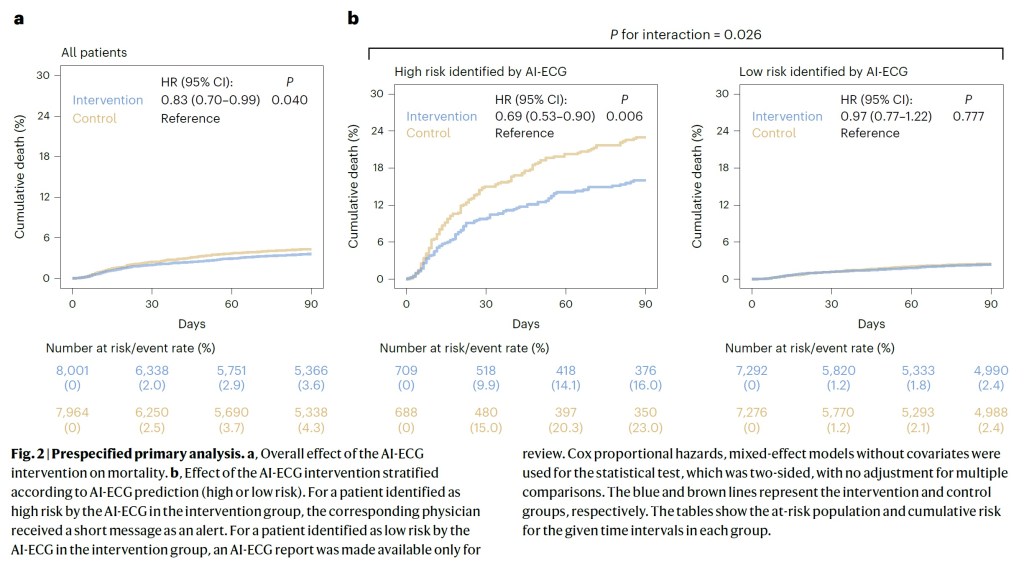
The early identification of vulnerable patients has the potential to improve outcomes but poses a substantial challenge in clinical practice. This study evaluated the ability of an artificial intelligence (AI)-enabled electrocardiogram (ECG) to identify hospitalized patients with a high risk of mortality in a multisite randomized controlled trial involving 39 physicians and 15,965 patients. The AI-ECG alert intervention included an AI report and warning messages delivered to the physicians, flagging patients predicted to be at high risk of mortality. The trial met its primary outcome, finding that implementation of the AI-ECG alert was associated with a significant reduction in all-cause mortality within 90 days: 3.6% patients in the intervention group died within 90 days, compared to 4.3% in the control group (4.3%) (hazard ratio (HR) = 0.83, 95% confidence interval (CI) = 0.70-0.99). A prespecified analysis showed that reduction in all-cause mortality associated with the AI-ECG alert was observed primarily in patients with high-risk ECGs (HR = 0.69, 95% CI = 0.53-0.90). In analyses of secondary outcomes, patients in the intervention group with high-risk ECGs received increased levels of intensive care compared to the control group; for the high-risk ECG group of patients, implementation of the AI-ECG alert was associated with a significant reduction in the risk of cardiac death (0.2% in the intervention arm versus 2.4% in the control arm, HR = 0.07, 95% CI = 0.01-0.56). While the precise means by which implementation of the AI-ECG alert led to decreased mortality are to be fully elucidated, these results indicate that such implementation assists in the detection of high-risk patients, prompting timely clinical care and reducing mortality. ClinicalTrials.gov registration: NCT05118035 .



 AGATA TEAM
Leave a comment